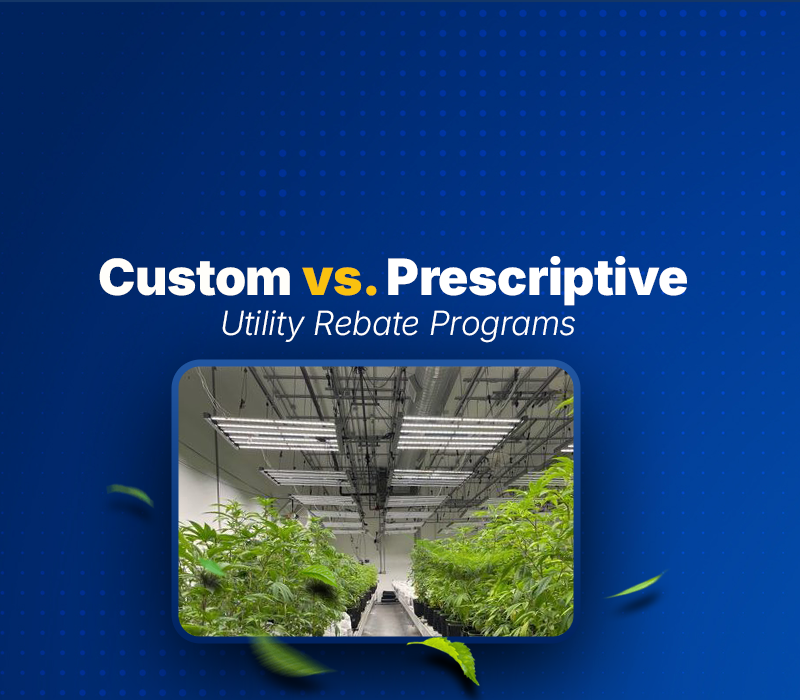
A prescriptive rebate pays a fixed, published dollar amount per qualifying fixture off a pre-approved list; a custom rebate instead calculates your incentive from the actual projected energy savings of a non-standard project, and Pacific Gas & Electric's own Custom Retrofit Program spells out rates of 75 to 200 dollars per kilowatt of demand saved specifically because that project type does not fit any prescriptive list (PG&E, 2026).
For a cannabis cultivator planning an LED retrofit, HVAC (heating, ventilation, and air conditioning) upgrade, or full facility redesign, knowing which track applies before you sign a purchase order changes your paperwork, your timeline, and sometimes your total incentive.
- What Is a Prescriptive Utility Rebate?
- Orange & Rockland Utilities, a Con Edison company, runs a Commercial and Industrial Prescriptive Rebate Program that pays up to 50 percent of the incremental measure cost using a published Prescriptive Measure and Incentive List, with separate calculators for lighting, HVAC, refrigeration, and variable frequency drives (Orange & Rockland Utilities, 2026). For a grower buying DesignLights Consortium (DLC)-qualified LED fixtures, this is usually the faster path: submit your spec sheets and invoice, and some rebates require a brief on-site verification inspection before the check goes out.
- What Is a Custom Utility Rebate Program?
A custom, or calculated, rebate program covers equipment or projects that fall outside the prescriptive list entirely, with the incentive amount calculated project by project from estimated energy savings rather than a flat per-unit rate. Wisconsin's statewide Focus on Energy program frames this directly as funding for upgrades not found in its prescriptive incentive catalogs (Focus on Energy, 2026).
- Custom programs typically cover non-standard applications: full facility retrofits, industrial process equipment, building envelope work, or renewable systems. Focus on Energy determines its custom funding by the estimated first-year energy savings of the specific upgrade, not a catalog price (Focus on Energy, 2026). Pacific Gas & Electric's Custom Retrofit Program exists specifically for equipment that is otherwise ineligible for a standard PG&E rebate (PG&E, 2026).
- The DesignLights Consortium's Qualified Products List exists precisely to make this decision easier: it lets a utility offer a rebate for any DLC-qualified fixture without individually testing the product itself, which is what makes prescriptive lighting rebates fast (DesignLights Consortium, 2026). DLC's current Horticultural Technical Requirements, version 4.0 and effective April 2025, raised the minimum qualifying photosynthetic photon efficacy (PPE), the light output per watt of electricity a fixture delivers as usable plant light, by 8.7 percent over the prior standard (DesignLights Consortium, 2025).
Custom Programs Require Pre-Approval First
Prescriptive rebates generally do not require pre-approval before you buy; custom rebates do. Pacific Gas & Electric requires prequalification before the purchase and installation of equipment under its Custom Retrofit Program, and the Department of Energy's own utility program materials confirm custom applicants must get preapproval before proceeding (PG&E, 2026; DOE/FUPWG, 2014).
That single difference is the one growers get burned by most. Buy equipment for a custom project before the utility signs off, and you can lose eligibility entirely, since the rebate is meant to fund a decision you have not yet made. A prescriptive purchase carries far less of that risk, since the equipment was already pre-vetted onto the list before you ever placed the order.
Which Utilities Run Both Tracks?
Several utilities run a prescriptive and a custom track side by side. Focus on Energy in Wisconsin separates equipment replacement from custom incentives; Pacific Gas & Electric pairs standard rebates with a Custom Retrofit Program; and Xcel Energy runs prescriptive, custom, and a studies and audits track feeding into either one (Focus on Energy, 2026; PG&E, 2026; DOE/FUPWG, 2014).
Program names and rules vary by state and even by utility territory within the same state, so a project that qualifies as custom in one service area might have a prescriptive line item in another. The U.S. Department of Energy's Database of State Incentives for Renewables and Efficiency (DSIRE) is the closest thing to a national index of what's currently available, though every program still has to be confirmed directly with the administering utility before you apply.
Do Custom Rebates Pay More Than Prescriptive Ones?
Not necessarily. Pacific Gas & Electric's custom incentive rates run 75 to 200 dollars per kilowatt of demand saved and 6 to 12 cents per kilowatt-hour depending on performance tier, which can outpace a flat prescriptive rebate on a large system, but a small, straightforward lighting swap is often better served by the simpler prescriptive path (PG&E, 2026).
- What Rebates never promises an outcome before we have looked at your facility's actual equipment and utility territory, because both the amount and the track depend on program rules that vary by state, by utility, and by year.
- 45% — the efficacy premium the DesignLights Consortium requires horticultural LED fixtures to hold over the most efficient non-LED option to qualify for its Qualified Products List, according to DesignLights Consortium (2025).
- Before you sign a purchase order for anything you plan to submit as a custom project, confirm your utility's pre-approval requirement in writing. Buying first and applying later is the single fastest way to forfeit a custom rebate entirely.
- Whichever track your facility falls into, the paperwork, timelines, and required documentation differ enough that guessing wrong costs real time. What Rebates handles the full process for cannabis cultivators, from confirming which track applies to a specific piece of equipment through submitting the application and following it to a check, for a fee of 10 percent of the rebate recovered. If you're planning an equipment upgrade and aren't sure which program fits, our team can look at your facility and your utility territory before you commit to a purchase order — reach out through our contact page at https://www.whatrebates.com/contact.
Questions Growers Actually Ask
Q: Can I switch a project from custom to prescriptive after I've already applied?
A: Usually not once the application is submitted under one track, since each track has its own approval process and paperwork. Confirm the right track with your utility or a rebate consultant before applying, since re-filing under the other track can delay your incentive by weeks.
Q: Do I need an energy audit to qualify for a custom rebate?
A: Often, yes. Custom programs calculate your incentive from projected energy savings, and many utilities require or strongly recommend a facility energy study to support that calculation before approving the project (DOE/FUPWG, 2014). A prescriptive rebate usually skips this step entirely.
Q: Are DLC-qualified LED grow lights always prescriptive?
A: Usually, since DesignLights Consortium-qualified fixtures sit on a pre-vetted Qualified Products List many utilities use directly for prescriptive lighting rebates (DesignLights Consortium, 2026). A large mixed-equipment retrofit that includes those same fixtures can still be filed as custom if the rest of the project doesn't fit the prescriptive list.
Q: What happens if I buy equipment before my custom rebate is approved?
A: You risk losing the rebate entirely. Pacific Gas & Electric and other utilities require prequalification before purchase and installation under their custom programs, and buying ahead of approval is treated as if the utility incentive played no role in your decision (PG&E, 2026).
Q: Is a custom rebate worth the extra paperwork?
- A: For non-standard equipment or a full facility retrofit, yes, since a custom rebate is often the only track available at all. For a straightforward, already-listed fixture swap, the simpler prescriptive path usually gets you paid faster with far less documentation.
- Sources:
- - U.S. Department of Energy / Federal Utility Partnership Working Group (FUPWG), 2014 — https://www.energy.gov/sites/default/files/2014/01/f7/fupwg_winter2014_Shockley%20.pdf
- - Focus on Energy (Wisconsin), 2026 — https://focusonenergy.com/business/custom-incentives
- - Pacific Gas & Electric, Custom Retrofit Program Catalog, 2026 — https://www.pge.com/content/dam/pge/docs/save-energy-and-money/rebate-and-incentives/custom-retrofit-catalog.pdf
- - Orange & Rockland Utilities, Prescriptive Rebate Program, 2026 — https://www.oru.com/en/save-money/rebates-incentives-credits/new-jersey-customers/incentives-for-business-customers-nj/prescriptive-rebate-program
- - DesignLights Consortium, Horticultural Technical Requirements V4.0, 2025 — https://designlights.org/our-work/horticultural-lighting/technical-requirements/hort-v4-0/
- DesignLights Consortium, Qualified Products Lists, 2026 — https://designlights.org/qpl/